HabitAI
An iOS habit tracker built in a day for two users. The point was to find out what's worth making when execution is cheap.
Opening
Mira mentioned she wanted a habit tracker. The kind of thing that, for most of software history, you either downloaded from someone else or didn't get. Building it yourself for one person wasn't worth a developer's time, and the off-the-shelf options never quite fit.
That gap is the thing I wanted to test. If vibe coding shortens the distance between an idea and a working product enough, a category of software opens up that didn't exist before — software made for one person, or two, by someone who isn't trying to find a market. HabitAI is the smallest thing I could build to find out whether that category is real.
The constraint was deliberate. iOS app, not a webpage — complex enough to count. No backend, no accounts, no sync — contained enough to finish. Two users: Mira and me.
What it is
Open the app, see today's habits as cards, tap to check them off. Score the day on a five-face mood scale. Write a note if you want to. Streaks, a calendar of past days, a home screen widget that knows whether you've started, are partway, or are done. Dark mode, one teal accent color, outlined icons. A JSON export, because at some point you'll want to paste your year into Claude and ask what it sees.
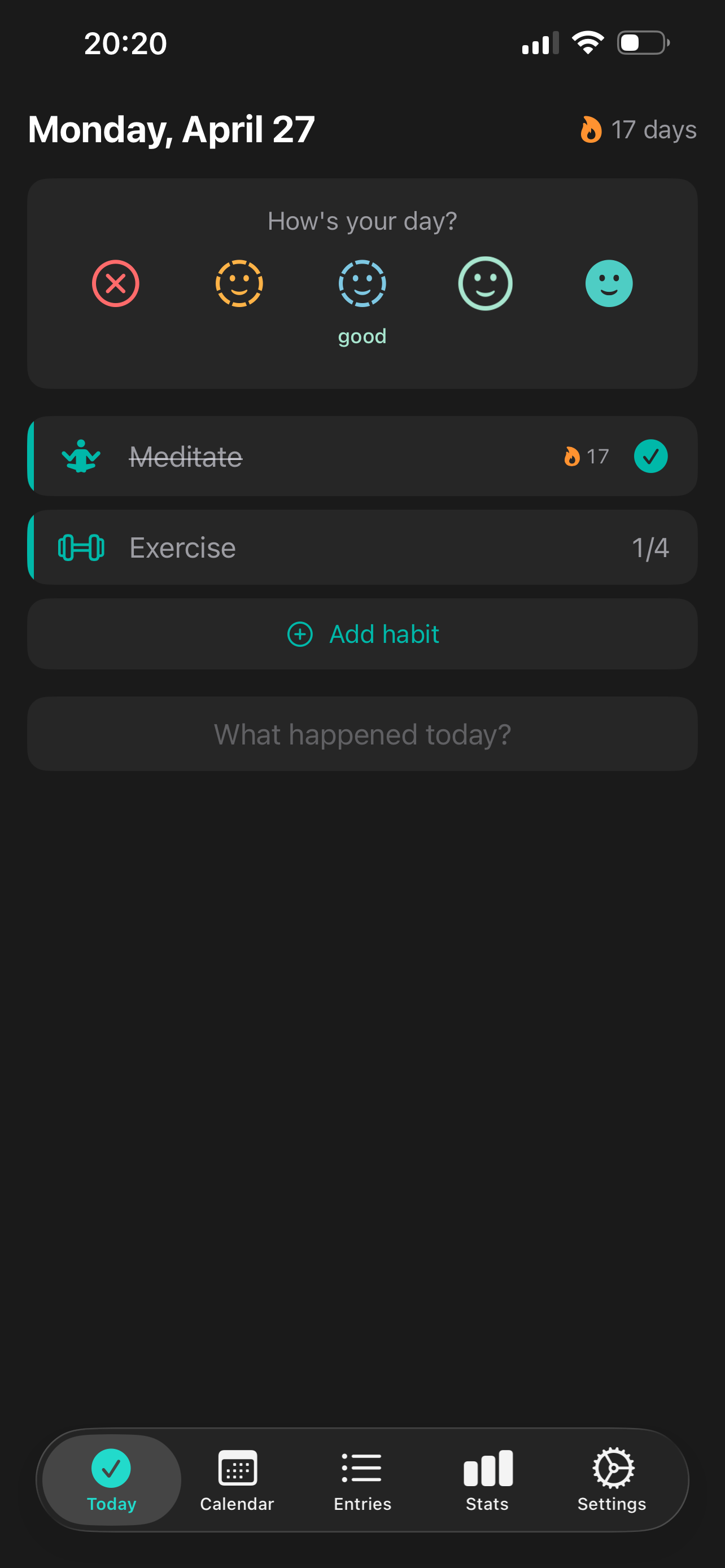
That's the product. There's nothing under the hood that needs explaining, because the point was to make something small enough that nothing under the hood needed explaining.
What use looks like
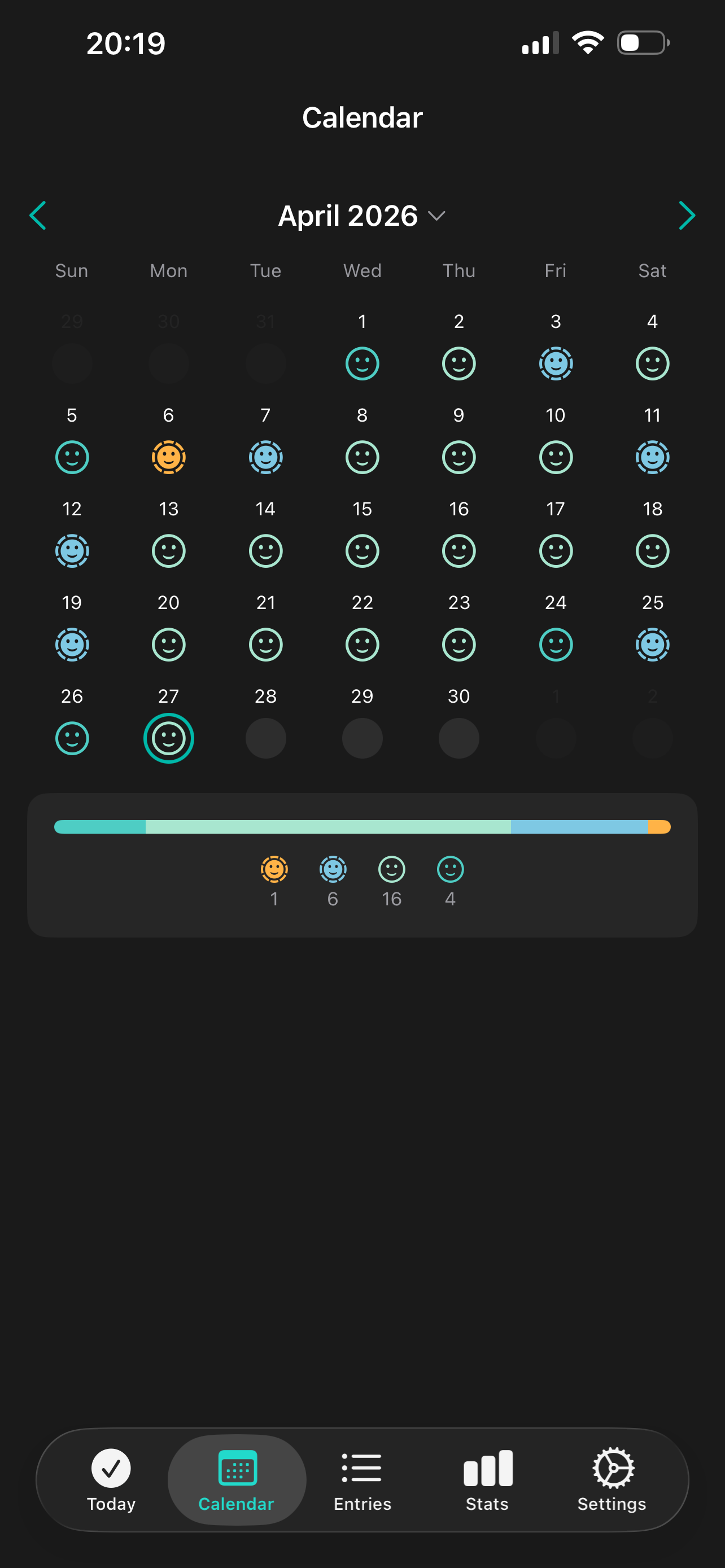
The calendar is the part of the app I open most. Weeks of teal smileys is its own kind of feedback — not gamified, not nagging, just a record of days that happened.
The build
Seven hours, one day, twenty-seven commits. First commit at 9:51 in the morning, last commit at 4:50 in the afternoon on March 8, 2026. A workout on the Peloton while Claude Code worked. Twenty-six tasks completed, 162 tests passing. I didn't read any of the code. I reviewed behavior, failures, and tests.
The scaffolding I used was the early version of what later became Building. Four roles, six stages, loose files on disk that hadn't been named yet. The smoke test stage didn't exist. The senior development manager didn't exist. The design specialist didn't exist. Most of what makes Building a working framework today was added in the months after, mostly in response to problems Nacre surfaced.
HabitAI ran cleanly through the smaller pipeline. The surface was small enough that the smaller framework was enough.
The category
HabitAI answers the narrow version of the question. Yes, you can build a working iOS app in a day for one user. What's worth holding onto is that this is the worst it will ever be: the least productized version of agentic coding, the most friction, the most stitching the maker still has to do by hand.
That doesn't mean every idea is now worth building. It means the cost of finding out has changed. A question that used to require a team, a roadmap, and a business case can now sometimes be answered with a Sunday, a phone, and two real users.
Closing
HabitAI is on TestFlight as a friends-and-family beta and isn't going wider. It doesn't need users, a roadmap, or a second version. It needs to work for Mira and me, and it does.
The frame I keep coming back to is disposable code. Not careless code — the tests pass, the app works — but code that doesn't have to outlive the question it was built to answer. If the question changes, the app gets rebuilt. If the question dissolves, the app gets deleted. Neither of those is a failure mode. Both of them are what makes the category interesting.
HabitAI is a Sunday's worth of work that two people use every day. That's the whole shape of the thing. The page exists because the shape is new, not because the project is.